

General commentary only. Not financial advice, and not an offer of any financial product.
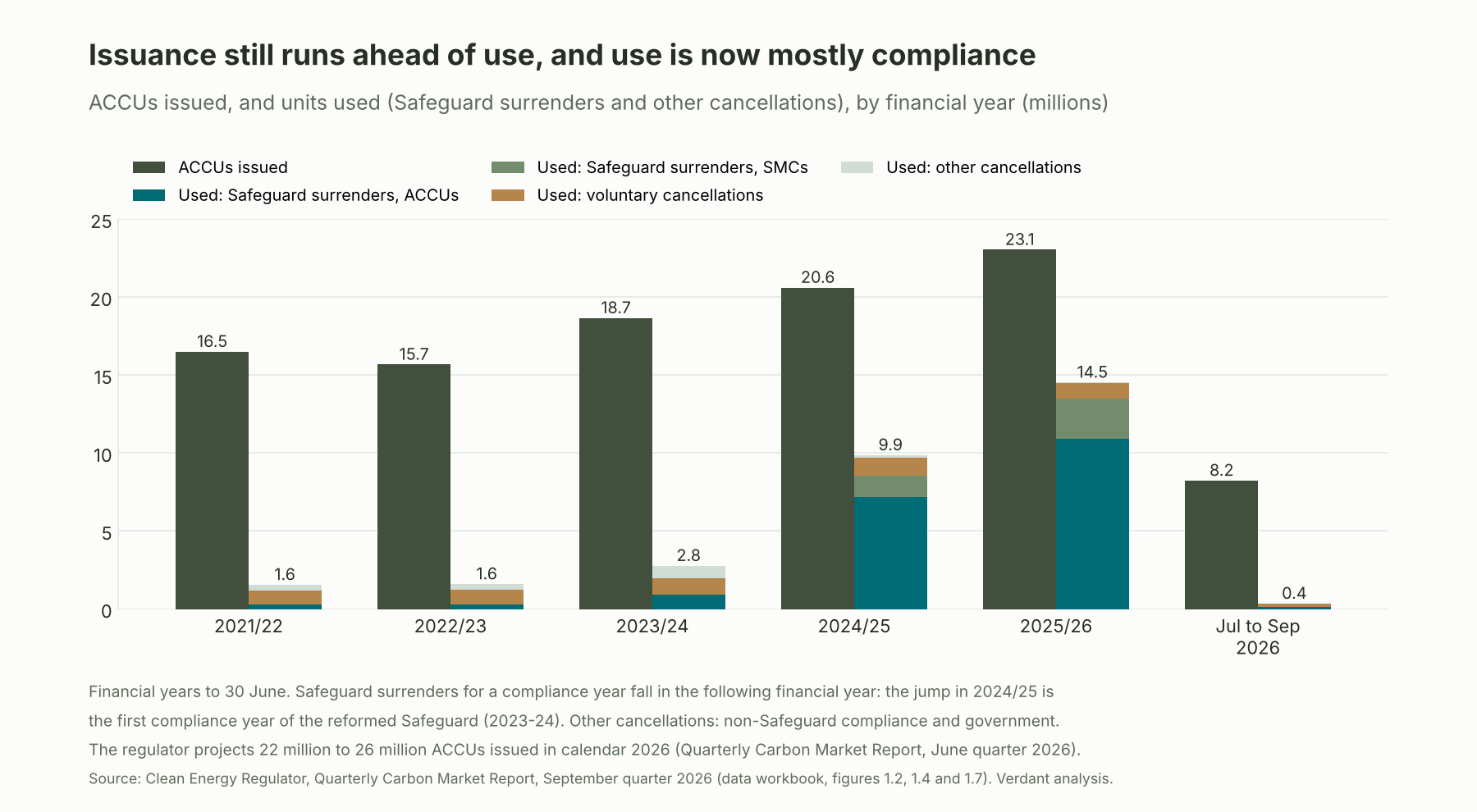
There is a comfortable stockpile of credits in Australia's carbon market at the moment: at 30 September, about 80 million Australian carbon credit units (ACCUs) and Safeguard Mechanism credits were held in the national registry. Issuance reached a record 23.1 million units in 2025/26, and another record 8.2 million issued in the September quarter alone. The Clean Energy Regulator's most recent projections, from June, still show supply exceeding demand for calendar 2026.
That stockpile meant the reformed Safeguard's first surrenders, due and delivered in 2024/25, could be met from supply on hand. But for anyone who will need high-integrity removals in the 2030s (a Safeguard facility, an ASX-listed company with a net zero commitment, a property developer delivering Green Star-rated buildings, a business whose customers are asking harder questions), three questions matter: what that supply is made of, what buyers and regulators will accept in the 2030s, and whether the two will meet in time.
Today's market runs on compliance
ACCU holdings grew by 9.4 million units over 2025/26, and by a further 7.7 million in the September quarter, to 68.9 million. Issuance is still running well ahead of use.
More than nine in ten units used in 2025/26 went to compliance. Australia's largest emitters, covered by the Safeguard Mechanism, surrendered about 13.5 million units that year (10.9 million ACCUs and 2.6 million Safeguard Mechanism credits), up from 8.6 million the year before, as the first compliance years of the reformed scheme came due. A Safeguard facility can meet its obligation with any ACCU, so compliance decides how many units the market needs.
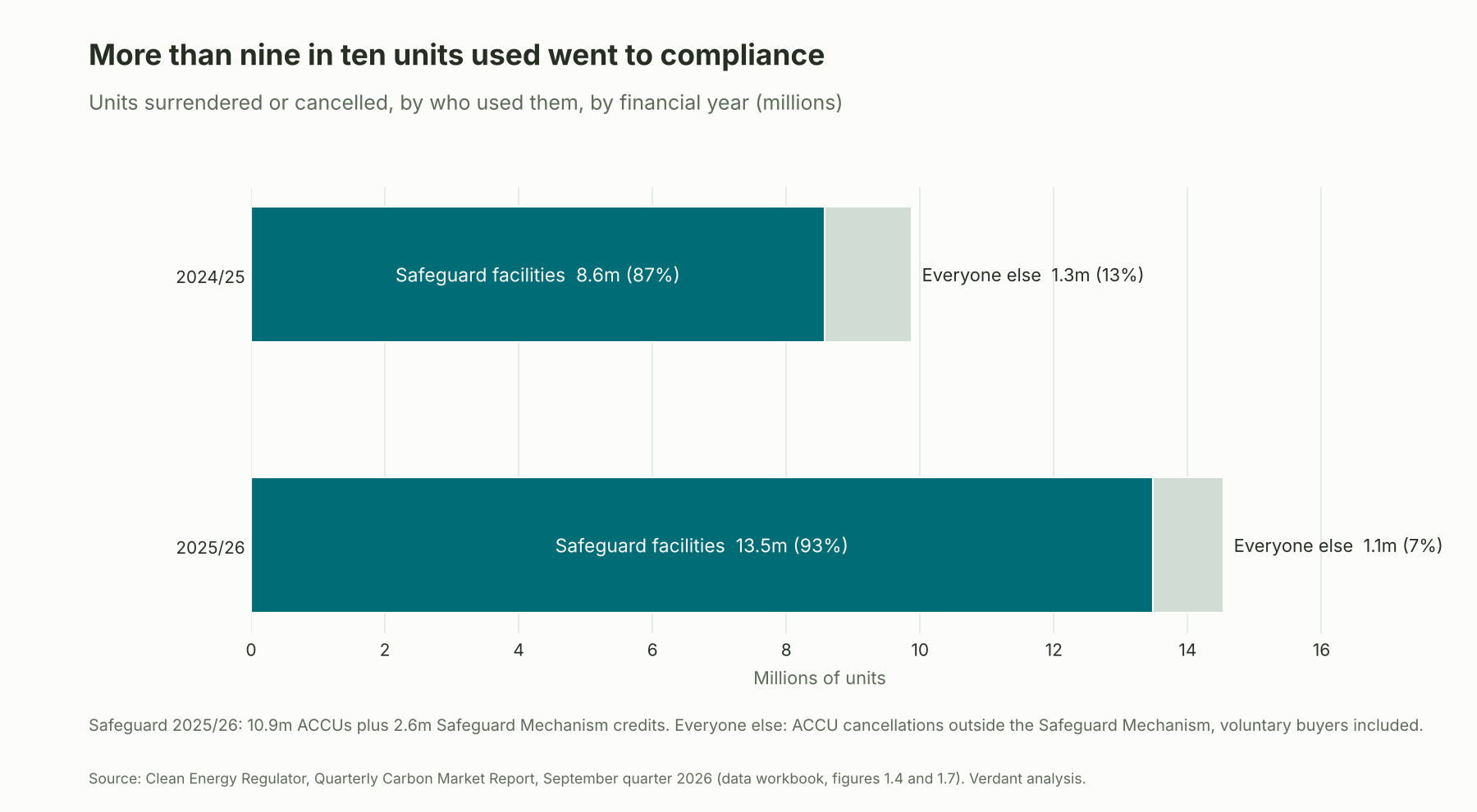
Everyone else, voluntary buyers included, cancelled about 1.1 million ACCUs in 2025/26, down from 1.9 million two years earlier. Voluntary demand may be losing its main domestic anchor: Climate Active certification is proposed to end in mid-2027 and a number of high-profile organisations have already dropped out of the program since 2023. How voluntary commitments will be demonstrated and certified to satisfy investors and customers remains to be seen over the next period.
Regardless, today there is no shortage of credits, and for now any ACCU will do for the bulk of demand. Why, then, does it matter what the stockpile is made of? Because the methods behind it are changing on both sides, avoided emissions and removals, and at the same time the rules on which units count are being reopened. What the supply is made of will decide how long it lasts and whether it is what 2030s buyers will accept.
What the supply is made of
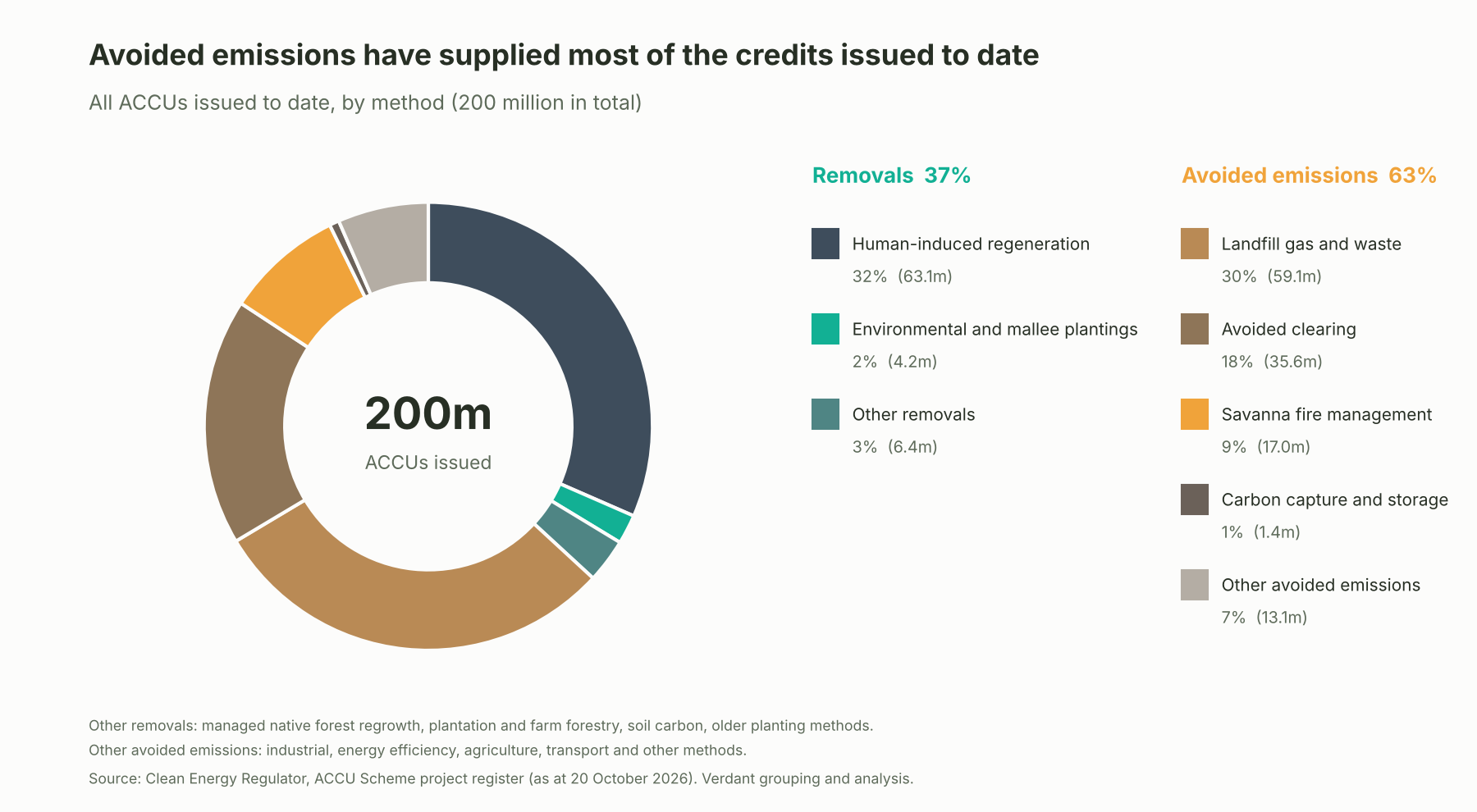
Credits come in two kinds: removals, which store carbon in vegetation or soil, and avoided emissions, for example from capturing landfill gas, burning savanna early in the dry season or not clearing land. In 2025/26 issuance was split 50-50 between avoidance and removals, but across all credits it’s worth noting that three methods carried the scheme: human-induced regeneration (HIR), landfill gas and avoided clearing. Between them they produced about two-thirds of the 23 million credits issued last year, and about three in four of the 200 million credits issued since the scheme began. All three methods are now closed to new projects or are in the process of being reset with major changes to how issuance occurs.
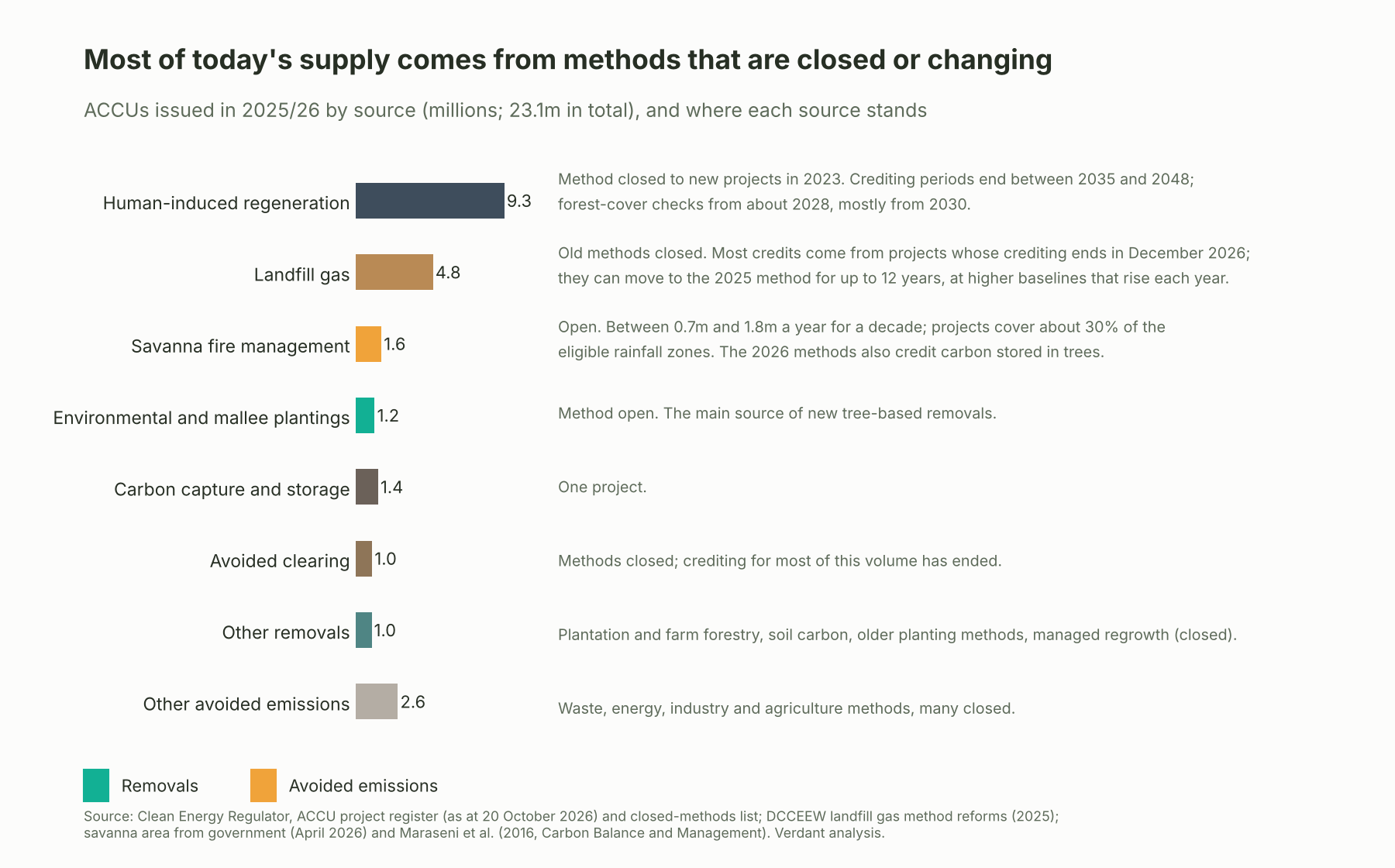
This matters because compliance is about to demand more of the stockpile and ongoing supply. Safeguard baselines tighten every year, the government projects ACCU surrenders to more than double by 2030, and the sources that carried the last decade (when Safeguard requirements were smaller) are the methods with uncertain futures. One market commentator's bottom-up model of the scheme already projects annual ACCU generation to trend down as older sources decline, and questions whether newer methods can scale fast enough to replace them.
Avoidance
Landfill gas, the largest source of avoided-emissions credits, is being reset. A landfill gas project earns credits for the methane it captures and destroys, less a baseline. About four in five of its credits come from long-running projects that joined the scheme with baselines of 0 to 24 per cent, so most of the methane they destroy has counted. Their crediting ends in December 2026. These projects can then move to the method released late last year, but at a higher baseline of 40 per cent for a site already generating electricity, rising half a point a year. For the same methane, a site that started at 24 per cent earns about a fifth fewer credits, and one that started at zero about two-fifths fewer. Critics might continue to question the method on additionality or other integrity principles, but the method will continue and the existing projects will be able to credit under the new method for 12 years at most.
Avoided clearing is further along. Its main method credited landholders for keeping native forest they could otherwise have cleared for cropping or grazing. It has issued about 35 million ACCUs to 64 projects, most of them registered in 2014 and 2015, and the method was revoked in 2023. Crediting ended for 48 of those projects in 2025. They are still reporting their final years (2.6 million units were issued to them between July and October), and then they stop. Another 13 are still crediting, to dates between 2030 and 2036, and issued about 0.3 million units in 2025/26. A smaller method for native regrowth expired in March 2025.
Savanna fire management, much of it Indigenous-led, is the exception. It remains open and has issued between 0.7 million and 1.8 million units a year for a decade. Its new methods, made in April, could lift output by crediting more of the avoided emissions and, for the first time, carbon stored in trees. It also brings jobs on country, and earlier, cooler fires in place of late-season wildfires. Its limits are land and weather. The method applies only in the northern rainfall zones, projects already cover about 30 per cent of them, and output moves with each year's fire season.
Removals
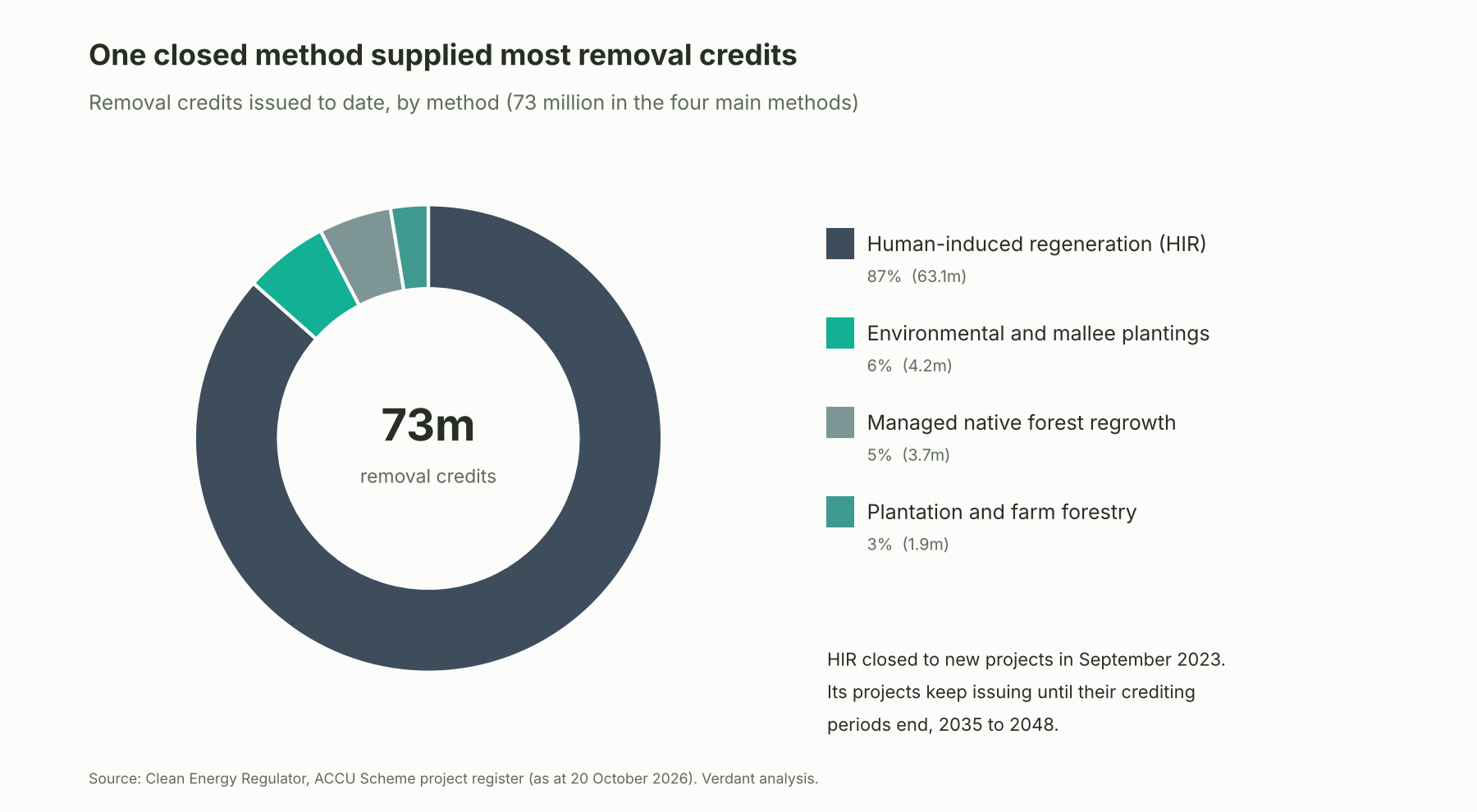
Removals tell a narrower story. Of the 200 million ACCUs issued to date, about 37 per cent were removals. The regulator's public project register lets anyone sort the more than 73 million removal credits by method. Human-induced regeneration, which manages land so that native vegetation regrows, supplied about 86 per cent. Environmental and mallee plantings supplied about 6 per cent, plantation and farm forestry about 3 per cent, and managed native forest regrowth, a smaller regeneration method, about 5 per cent.
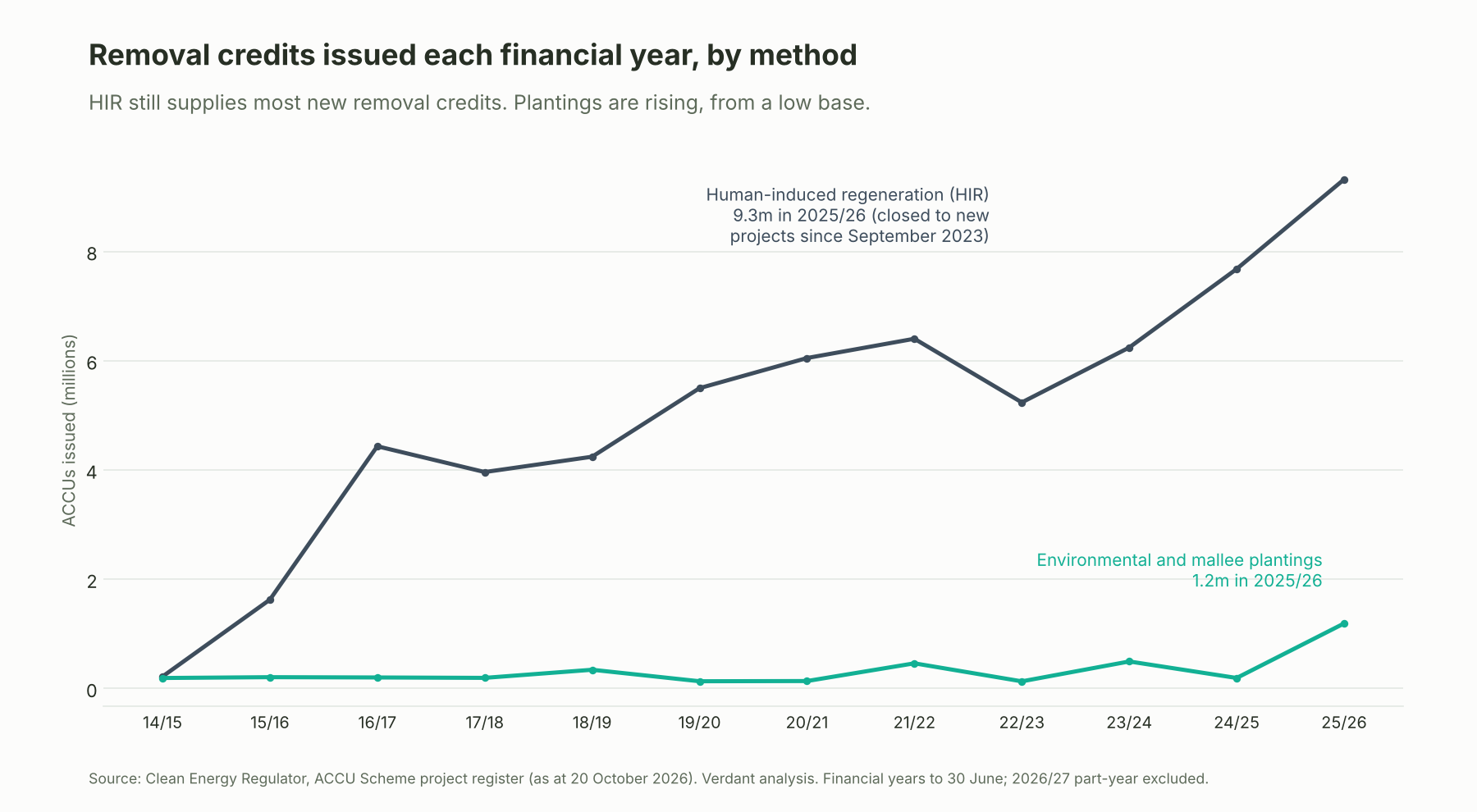
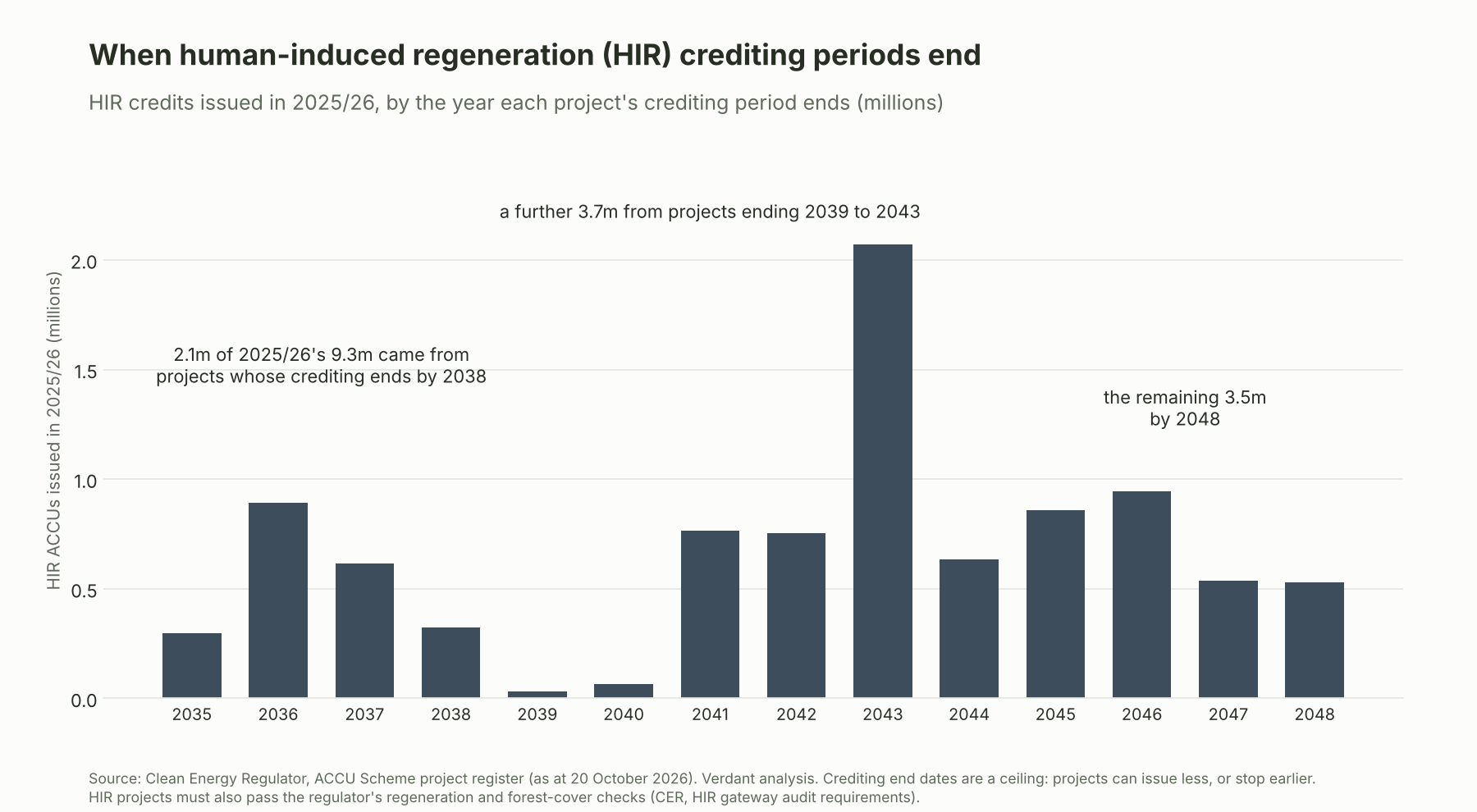
Human-induced regeneration closed to new projects when its method expired at the end of September 2023. The register shows 103 new projects in 2023, and none since. Existing projects keep issuing until their crediting periods end, between 2035 and 2048, and their issuance is still rising: 5.2 million units in 2022/23, 9.3 million in 2025/26. So the largest source of removal credits is still growing, but it is a closed book.
There are also risky headwinds for HIR projects over the next 10 to 20 years. The regulator checks each project's regrowth, generally at years 6 and 10, and its forest cover between years 15 and 20. A project that fails these checks gets no further credits until it is fixed; areas that miss the mark are removed, and the project may have to hand credits back. Most of today's supply could have an expiry date sooner than expected.
What replaces it
New tree-based removals now come mainly from environmental plantings. In 2025, 50 environmental planting projects registered, covering about 153,000 hectares within their boundaries. Another 36 (at least 43,000 hectares) have registered so far this year. A further 43 plantation projects registered in 2025 involve establishing new trees (about 51,000 hectares); most other plantation registrations credit existing plantations for continuing to produce wood products beyond the current crop. Environmental plantings issued about 1.2 million units in 2025/26, up from about 0.2 million the year before.
Human-induced regeneration may also return. The draft integrated farm and land management method includes regeneration on cleared land and on suppressed land, alongside plantings. Its rules are tighter than the method that closed: a 20-year baseline, low starting biomass, a land management strategy signed off by a qualified person, forest cover reached within the crediting period, and extra discounts until its measurement is proven. The government has said it intended to put the final method to the scheme's independent assurance committee in 2026. No estimate has been published of how much land, or how many credits, the new schedules could reach.
Soil carbon registers more new projects than any other method (211 in 2025), and of its nearly 1,000 active projects around 50 have issued credits so far. Together they have issued about half a million ACCUs, about 0.2 per cent of the scheme's credits to date: registrations have not yet turned into volume.
Forest protection is growing too. In October the regulator declared the first project under a new method for public native forests: about 532,000 hectares in north-east New South Wales, the step that lets the state reserve the Great Koala National Park. It earns credits by stopping harvesting across about 117,000 hectares, which keeps and continues to increase carbon stored in the trees. It can issue after everyone with an interest in the land has consented.
Almost all of this new supply takes time. A forest project needs consents before its first credit, a new regeneration method has to be made before anyone can register under it, and a planting takes years to grow from registration to its first credit.
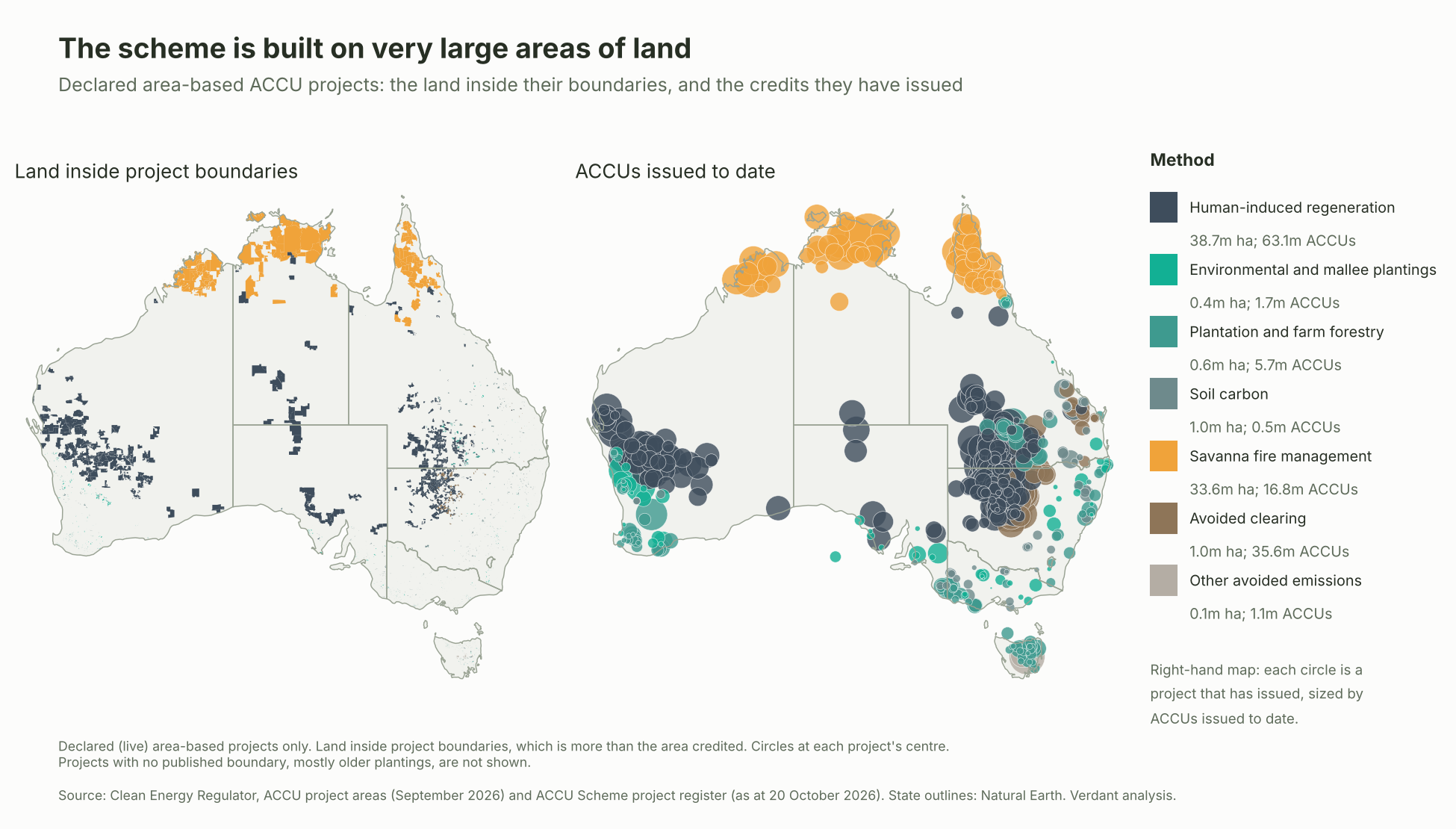
It also takes land. The methods that built the scheme work at landscape scale: regeneration projects cover about 39 million hectares, mostly in dry country, and savanna projects about 34 million. As the older methods close and the rules for new ones tighten, growth has to come from land that stores more carbon per hectare. Optimising supply relies on finding the right land, with the support of the people who live on and around it, and planting it well.
Planting is a different kind of asset
While both are classed as removals, environmental plantings (EP) differ from human-induced regeneration and other removal methods. A planting needs land that qualifies and that someone can control for the whole permanence period (25 or 100 years). It needs establishment capital spent up front, well before most of the credits arrive. And it needs measurement that will satisfy an auditor, and active management for decades. It also comes with significant co-benefits for nature, biodiversity, First Nations Australians and local communities.
The more sophisticated buyers and standards are starting to apply four tests to sift through the supply and then maximise their impact and ensure the durability of credits to address residual emissions: a removal rather than an avoided emission; diverse local native species rather than a monoculture; additional carbon, from a new planting that would not exist without the project; and long hold permanence of 100 years rather than 25. Each is checkable on the public register or in a project's documents. Apply all four and the pool is small: environmental plantings with 100-year permanence account for about 4 million of the 200 million ACCUs issued to date, about 2 per cent. That is how a market with 80 million spare units can still be short of one kind with rising demand. If rules or standards come to require that kind, the squeeze arrives for buyers.
International guidance points the same way. The Oxford Offsetting Principles, revised in 2024, say "organisations must shift towards carbon removals"; the ISO's net zero guidelines allow only removals to balance residual emissions; and the Science Based Targets initiative requires removals for whatever a company can't cut by its net zero year.
The same expectations are reaching Australian buyers across sectors. Under the mandatory climate reporting standard, AASB S2, large companies with a net emissions target must disclose how far they rely on carbon credits, which scheme verifies them, whether they are nature-based or technological, and whether they come from removals or reductions. The NSW Government's guide for its own agencies steers them to ACCUs and to credits with co-benefits, even at a higher price. In property, the Property Council of Australia's offsets framework, prepared with the Green Building Council of Australia's support, allows only removals to balance residual emissions and gives preference to nature-based removals. The Green Building Council's Nature Positive Roadmap, released in March, adds a principle to invest in nature restoration, so credits like plantings begin to deliver double duty.
A 100-year commitment raises the questions any long land commitment does: whether neighbours and Traditional Owners support it, whether trees are the best use of that land, and whether it can be delivered at a price buyers will pay. Most planting proponents have already made that commitment: 215 of 373 environmental planting projects, carrying about 98 per cent of the method's credits issued, chose 100-year permanence. Most regeneration projects (365 of 529, and about three in five of their credits issued) chose 25.
A pipeline is not a harvest. Will EP deliver?
If 100-year planted removals are what the 2030s will want, the planting pipeline looks like the answer, and it is not small. Nearly 300 environmental planting projects, covering about 330,000 hectares within their boundaries, have registered since 2022. If that wave delivers at scale, it answers much of the concern about removals in the 2030s.
An EP project issues only once its trees have established and been measured and not every registered project gets there. So far, 33 of the 298 registered since 2022 have issued: about 151,000 units between them, from about 31,000 hectares. That’s less than ten per cent of the cohort's area. Many may simply be too young to issue; among older planting projects that have issued the first credit typically came four to five years after registration. Following this same pattern, the youngest of this wave will reach their first credits around 2030, with most of their volume after that.
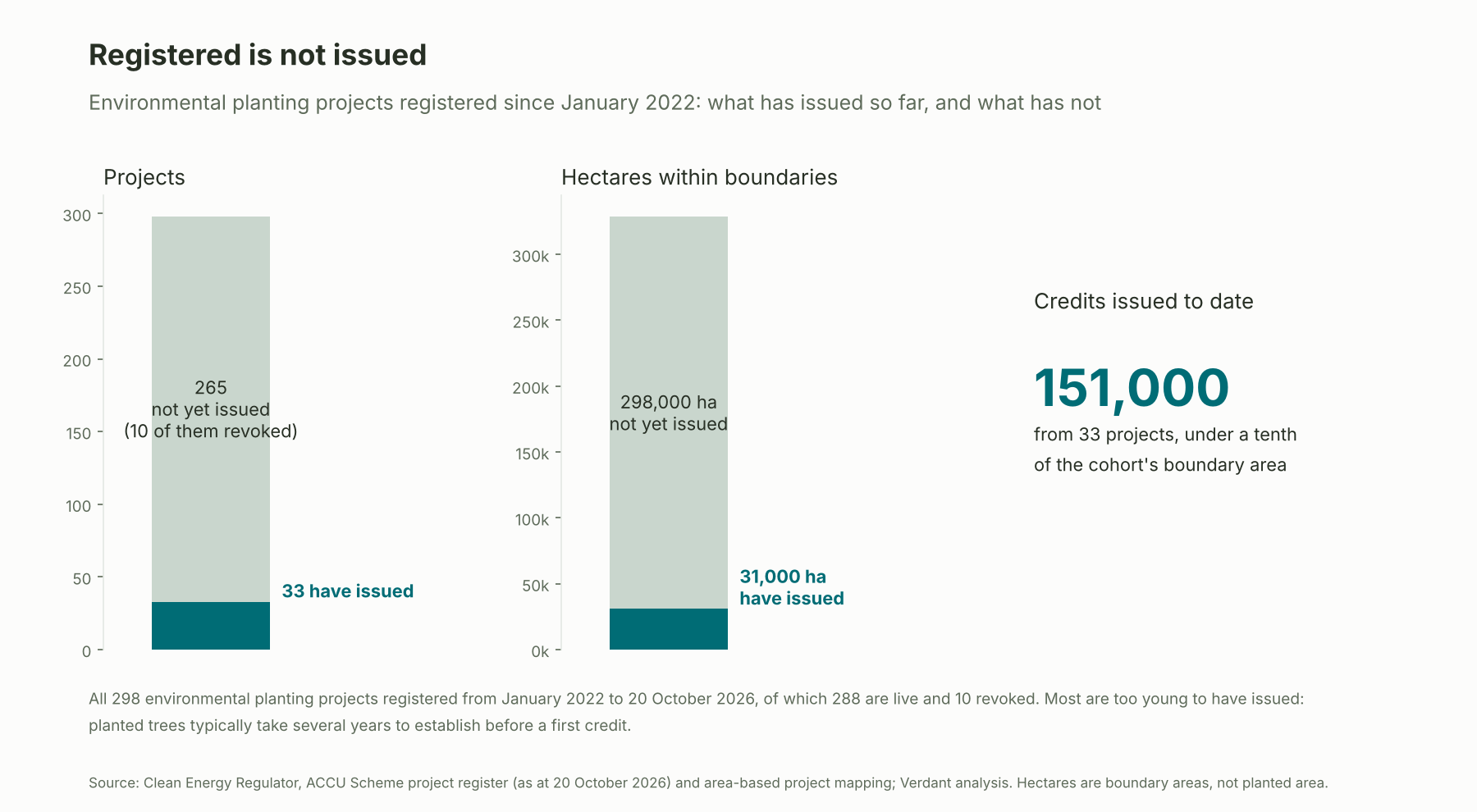
There are other factors that could be impacting this delay of issuance, such as the average size of projects, which might not carry over to newer projects, but based on the current data, the older cohort is a guide to what could happen next. Of the 71 environmental planting projects registered more than five years ago, 37 have never issued a credit, and 30 of those have since had their registration revoked. Why a project has not issued, or was revoked, varies: trees still growing, plantings that did not establish, or projects that did not proceed. Verdant's spatial assessment of the register found that the recent projects still waiting past the usual lag are mostly smaller ones, not necessarily projects on lower quality land. Getting the site, the plan, the scale and the funding right at the start is what turns a registration into a tonne.
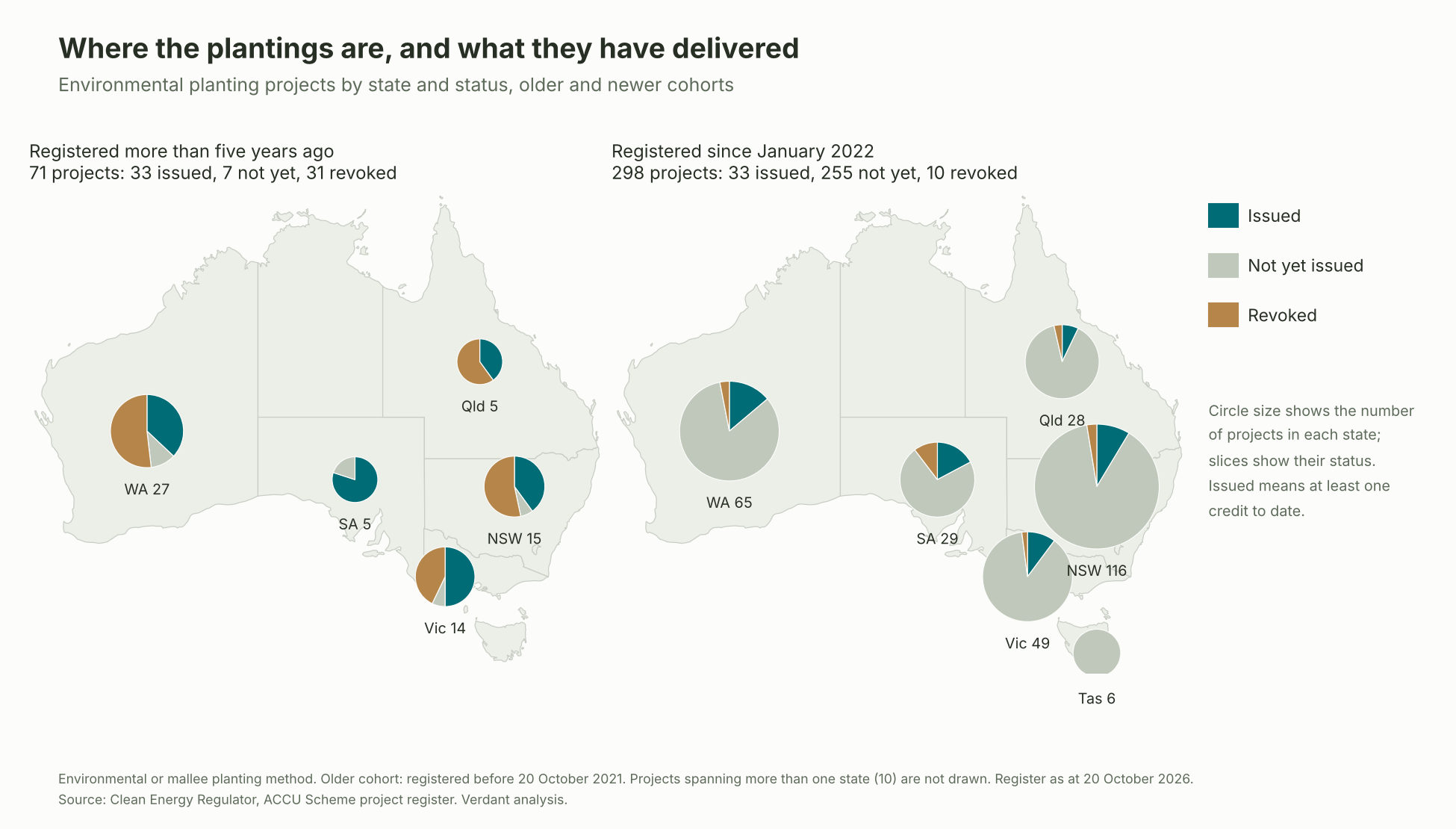
The question for the 2030s, then, is how many high-integrity planted tonnes will be in the ground and verified when buyers need them, and who is making sure they will be.
What the 2030s will ask for
Compliance demand rises from here. Safeguard baselines fall by 4.9 per cent of their starting level each year to 2030, and the law already sets the goal of net Safeguard emissions reaching zero by 2050. How fast they fall after 2030 is being settled right now, in the Safeguard Review due to set out its positions early next year. The default is about 3.3 per cent a year; Australia’s 2035 Paris Nationally Determined Contribution (NDC) target points to something steeper. In its December 2025 quarterly report, the regulator said annual demand "may surpass annual supply later this decade". If it does, the market will start drawing down the stockpile rather than adding to it.
The kind of unit is coming into question as well. The Climate Change Authority has recommended that the Safeguard Review assess whether ACCUs from 25-year permanence projects "provide sufficient durability" for Safeguard compliance, and the review is also canvassing limits on which ACCUs can be used, for example by method or vintage. The stakes for supply are large. Units from 25-year projects made up 22 per cent of Safeguard surrenders in 2024/25, and about a third of all ACCUs issued in 2025/26 (7.6 million of 23.1 million). If the review limits them, that share of today's supply stops counting for the market's main buyer. Avoided-emissions methods such as landfill gas carry no permanence period, so the durability question doesn't reach them, but avoidance methods may be reducing in total issuance over the next decade. Permanence is becoming a key question asked of every stored tonne.
Australia's scheme already prices permanence, by degree: 25-year projects take a 20 per cent discount on their credits. Whether that is enough for Safeguard use is now a question for the review, if the government takes up the Authority's recommendation. Corporate standards set the bar higher again. The Science Based Targets initiative's revised net zero standard, which companies can use for targets from February 2027, expects larger companies to take responsibility for a rising share of their ongoing emissions with removals from 2035. Companies don't have to wait: until then, the standard recognises those that take this on voluntarily, at three levels up to 'Leadership'. It separates short-lived removals, which store carbon for decades to centuries, from long-lived ones that store it for centuries to millennia, and expects a growing share of the long-lived kind. Tree-based removals generally sit in the short-lived group and within that group a 100-year commitment with active management is stronger, but if trees are to be rewarded for permanence, Australia's own rules may do the heavy lifting.
A few large emitters are not waiting. Last year a Canadian pension fund and the Clean Energy Finance Corporation committed A$250 million to an Australian farming and planting platform, with a global miner signed as the foundation buyer of its credits. They are early movers and, for now, the exception. Most of the market has yet to make the same commitment, which leaves time for others to follow before the 2030s.
The timing trap
Start with the market as a whole. The government's consultation paper for the Safeguard review, published in August, projects compliance demand of 26 million ACCUs in 2030 and 35 million in 2035. It expects about 20 million ACCUs a year to be issued to 2030: a gap of about 6 million units in 2030 alone. It describes the Safeguard's remaining task to 2030, 140 million tonnes, as roughly equal to the ACCUs held when it was written (around 59 million) plus that expected issuance. Issuance has been running above the government's figure (23 million in 2025/26), so demand may pass issuance later than the projections imply.
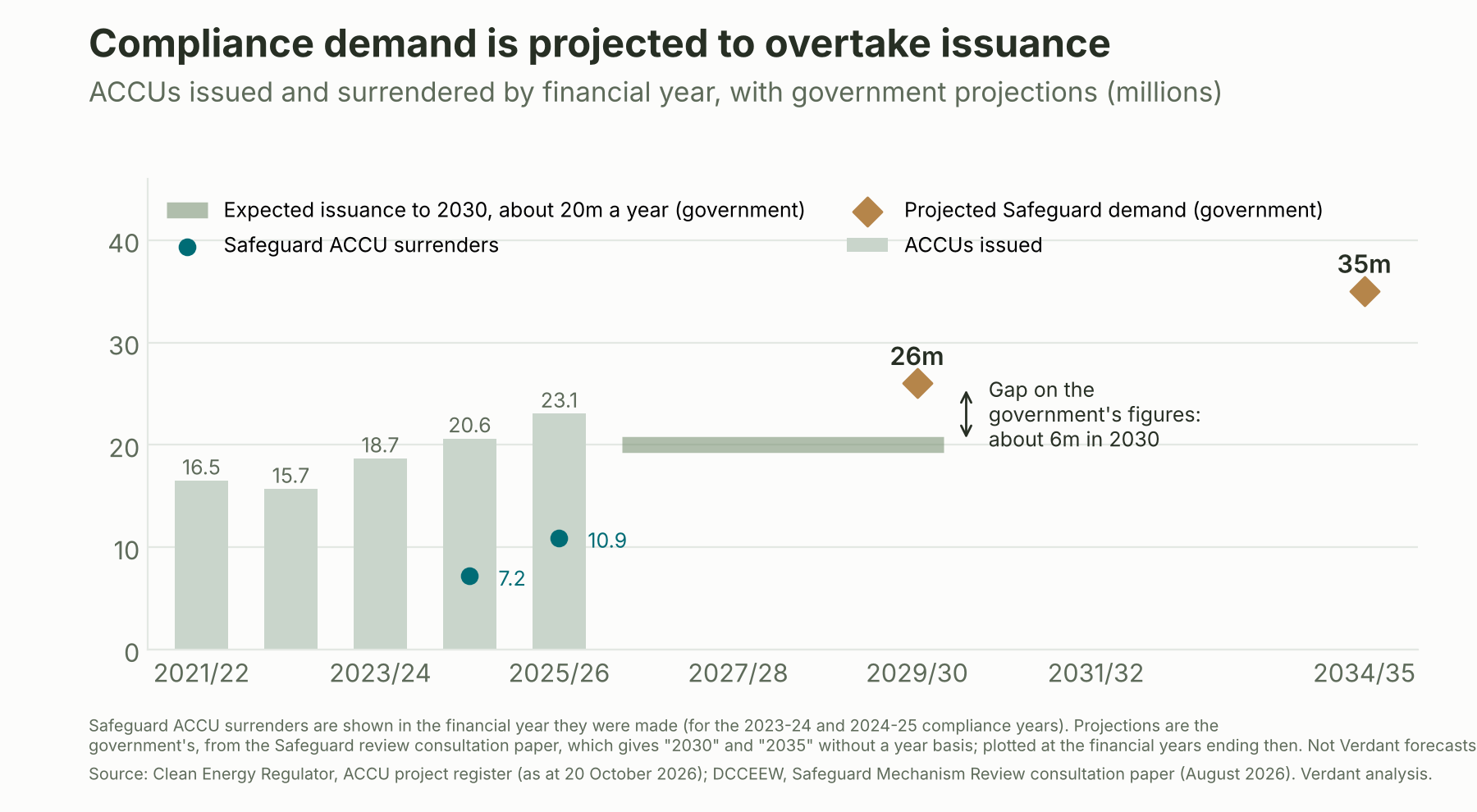
Today's holdings of about 80 million units, ACCUs and Safeguard Mechanism credits together, are roughly three years of the demand projected for 2030. Behind the market sits a government reserve. It holds ACCUs delivered under Commonwealth contracts and sells them once a year, at a fixed price ($87.72 a unit in 2026-27), only to Safeguard facilities over their baselines.
What fills that gap is still open. On the avoided-emissions side, savanna's new methods, carbon capture and public native forests could add supply, while landfill projects resetting at lower credit rates and closed methods running out take it away. The Safeguard settings after 2030 will decide how much compliance demand there is to meet.
On the removal side the direction is clearer, even where the volume is not: regeneration's crediting periods begin ending in 2035, a new regeneration route is still in draft, and planting is the main route adding to supply now.
A few other settings will also move the balance. Facilities that beat their Safeguard baselines earn Safeguard Mechanism credits they can surrender instead of ACCUs: 6.7 million were issued for 2024-25, down from 8.3 million the year before. How many more follow depends on how fast heavy industry cuts below its baselines; in the resources sector, the Climate Change Authority found that some technologies to decarbonise "are not yet mature". About two-thirds of the ACCUs held at 30 September sat with Safeguard facilities and their related companies, so less of the stockpile is for sale than the headline suggests. Regeneration's forest-cover checks could trim its supply. And a higher price would draw out more supply, faster from some methods than others.
Most buyers appear rational, today. With around 80 million units in hand, and both the post-2030 Safeguard path and the 25-year question still open, a long contract for a durable tonne can look like a bet on rules and supply that aren't settled yet, even if the direction looks clear. Yet a planting established in 2027 delivers most of its credits in the 2030s and beyond. That is when regeneration supply starts to roll off, and when demand for durable removals has had years more to build.
Supply that waits until demand is visible will be planted too late. By then, the window to plant for the early 2030s has closed: the spot market can’t shorten the lead time because biology and land set it.
In short: the market has plenty of credits and a large stockpile. But most of today's supply is on a clock, and on the government's own projections compliance demand passes annual issuance around 2030. What the market does not have, and cannot conjure quickly, is a pipeline of high-integrity planted removals sized for the 2030s, and capital committed early enough to build it.
Today a 100-year planted tonne earns the same as any other ACCU. But the rules might change. Voluntary standards and preferences are already turning to removals, and Australia's own rules have opened the questions of eligibility, durability and integrity to prioritise them as well.
What would change this view? Safeguard settings after 2030 that loosen rather than tighten; a planting pipeline that delivers far more of its registrations than earlier cohorts did; a new regeneration method that restores volume at comparable integrity; or new avoided-emissions and forest-protection supply that keeps the stockpile growing well into the 2030s.
Regardless, all of this leaves questions: How much will today's planting pipeline actually deliver, and when? Who will buy ACCUs in 2035, and what will they accept? What happens to regeneration supply as projects reach their forest-cover tests? Where will new methods find suitable land, with the social licence to use it, at the volumes required? Will the 2030s pay for durability? And who finances the plantings the 2030s need, before the buyers sign?
Demand is growing. The real question is whether supply will have taken root in time.